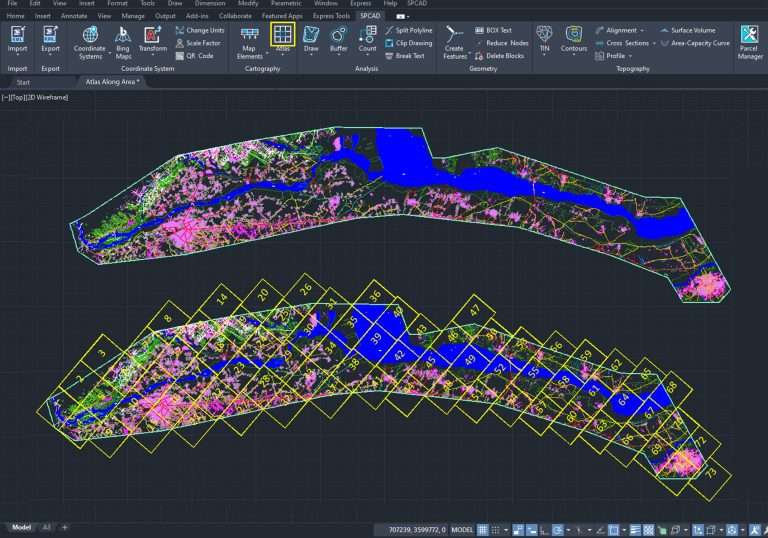
Cadastral Mapping and Lot-Subdivision using SPCAD

Introduction
Cadastral mapping forms the backbone of every well-planned city. In fact, accurate subdivision of land into lots and parcels not only determines property ownership but also directly influences the efficiency of future urban development. Traditionally, these processes required extensive time, manual precision, and multiple rounds of revision. However, with SPCAD, cadastral mapping has now evolved into a streamlined and automated system that integrates seamlessly with parcel management.
Moreover, SPCAD’s powerful suite of tools ensures that every land division is fair, accurate, and fully compliant with planning standards. Through its methods for lot division, parcel management, and data export, SPCAD empowers urban planners, surveyors, and municipal authorities to make informed, transparent, and future-ready decisions. As a result, the entire cadastral mapping process becomes faster, more reliable, and perfectly aligned with modern city planning needs.
For more details, read our help documentation:
https://help.cadomation.com/spcad/docs/spcadhelp/cadaster/
Lot Division Methods in SPCAD
1. Perpendicular to Side Lot Line
- Firstly, this method ensures that subdivisions are aligned at right angles to the chosen side boundary. In urban planning, this is crucial because it works best for rectangular and straight-line plots where symmetry and uniform lot depths enhance usability. Moreover, it creates orderly street grids, ensures equal access to infrastructure, and, as a result, minimizes disputes over irregular boundaries.
- For more details, read our help documentation: https://help.cadomation.com/spcad/docs/spcadhelp/cadaster/ddx/
2. Perpendicular at Fixed Front Line
- Why to Use:
- Frontage plays a vital role in urban real estate value and accessibility. By keeping divisions perpendicular to a fixed front line, planners can guarantee uniform frontage widths. This is particularly useful for commercial corridors, where equal exposure to roads boosts business viability, and for housing schemes that require consistent street-facing plots.
- For more details, read our help documentation: https://help.cadomation.com/spcad/docs/spcadhelp/cadaster/dfg/
3. Parallel Area to Front Line
- Why to Use:
- Some zoning regulations demand uniform depths or setbacks from the front line. Therefore, this method maintains parallel alignment with the frontage, ensuring balanced land use. In addition, it prevents irregular back plots and is especially ideal for housing colonies where equal depth ensures fair distribution of land utility and compliance with planning codes.
- For more details, read our help documentation: https://help.cadomation.com/spcad/docs/spcadhelp/cadaster/ddff_sp/
4. Across Lot Width Line
- Why to Use:
- Quick and efficient, this method is best for dividing lots laterally across their width. In particular, it is valuable in high-density residential planning, where the goal is to maximize the number of standardized lots within a limited space. Moreover, this tool offers speed and uniformity. As a result, it simplifies subdivision without compromising order.
- For more details, read our help documentation: https://help.cadomation.com/spcad/docs/spcadhelp/cadaster/ddy/
5. Across the Front Lot Line
- Why to Use:
- This method ensures that subdivisions align with the lot’s front boundary. It is most valuable in commercial and mixed-use developments, where frontage determines both accessibility and property value. By maintaining consistency with the main access road, planners can create visually coherent and functionally strong layouts.
- For more details, read our help documentation: https://help.cadomation.com/spcad/docs/spcadhelp/cadaster/ddz/
6. Distance Along Cutting Edge
- Why to Use:
- Precision is often required in urban layouts, especially when legal distances, right-of-ways, or specific offsets must be observed. The ‘Distance along cutting edge’ method allows subdivision along exact measured distances from a defined cutting edge. This ensures compliance with zoning laws, road expansions, or utility corridors, making it indispensable in regulated environments.
- For more details, read our help documentation: https://help.cadomation.com/spcad/docs/spcadhelp/cadaster/ddf/
7. Quick Division Tools
SPCAD also offers versatile, quick division options that cater to diverse planning scenarios:
- By Area: Ensures equitable land allocation when dividing land into specific area requirements. Useful in urban redevelopment where different zones (parks, schools, residential) must meet area quotas.
- For more details, read our help documentation:
https://help.cadomation.com/spcad/docs/spcadhelp/cadaster/dva/
- For more details, read our help documentation:
- By Percentage: Ideal for strategic planning, where land must be divided proportionally between uses, such as 40% residential, 30% commercial, 20% open spaces, and 10% institutional.
- For more details, read our help documentation:
https://help.cadomation.com/spcad/docs/spcadhelp/cadaster/dvp/
- For more details, read our help documentation:
- By Number of Divisions: Speeds up the process of splitting land into equal parts when uniformity is the main requirement, such as affordable housing projects.
- For more details, read our help documentation: https://help.cadomation.com/spcad/docs/spcadhelp/cadaster/dvn/
- Quick Division: The most flexible option, designed for rapid subdivisions without detailed manual calculations. A time-saver for preliminary layouts and feasibility studies.
- For more details, read our help documentation:
https://help.cadomation.com/spcad/docs/spcadhelp/cadaster/dvd/
- For more details, read our help documentation:
Parcel Manager in SPCAD
Why to Use
- Urban planning doesn’t end with lot division; it requires organization, annotation, and record management. Parcel Manager in SPCAD transforms raw subdivisions into well-documented cadastral schemes.
- Construct Parcel: Converts drawn schemes into recognized, manageable parcels.
- For more details, read our help documentation: https://help.cadomation.com/spcad/docs/spcadhelp/cadaster/dppf/
- Annotate Parcel: Labels each parcel with essential details (area, ID, dimensions) for easy identification and record-keeping.
- For more details, read our help documentation: https://help.cadomation.com/spcad/docs/spcadhelp/cadaster/dlp/
- Manage Parcels: Centralizes updates, modifications, and reconfigurations, ensuring that plans remain consistent with urban regulations.
Parcel Manager thus bridges the gap between design and documentation, making schemes ready for submission to regulatory authorities or integration into GIS systems.
For more details, read our help documentation:
https://help.cadomation.com/spcad/docs/spcadhelp/cadaster/lsm/
Exporting Lots
Why to Use
- Once subdivisions are finalized, exporting them into tables, schedules, or detailed parcel lists becomes essential. In fact, this function ensures transparency, allowing planners to present their work clearly to municipalities, developers, or community stakeholders. Moreover, exported data accelerates the approval process, supports legal documentation, and ultimately provides a reliable record for future reference.
- For more details, read our help documentation:
https://help.cadomation.com/spcad/docs/spcadhelp/cadaster/xltable/
https://help.cadomation.com/spcad/docs/spcadhelp/cadaster/xlcsv/
https://help.cadomation.com/spcad/docs/spcadhelp/cadaster/xlkml/
https://help.cadomation.com/spcad/docs/spcadhelp/cadaster/xlshp/
- For more details, read our help documentation:
Conclusion
Cadastral mapping is not just about dividing land; it is about shaping cities for efficiency, equity, and sustainability. SPCAD provides the precision and flexibility urban planners need, whether it is through carefully chosen lot division methods, parcel management, or seamless exporting. By integrating SPCAD into cadastral workflows, lot sub-division and annotation move beyond manual effort to a future of accuracy, transparency, and smarter city–building.